Category Archives: Artists

RECYCLING ART NOUVEAU

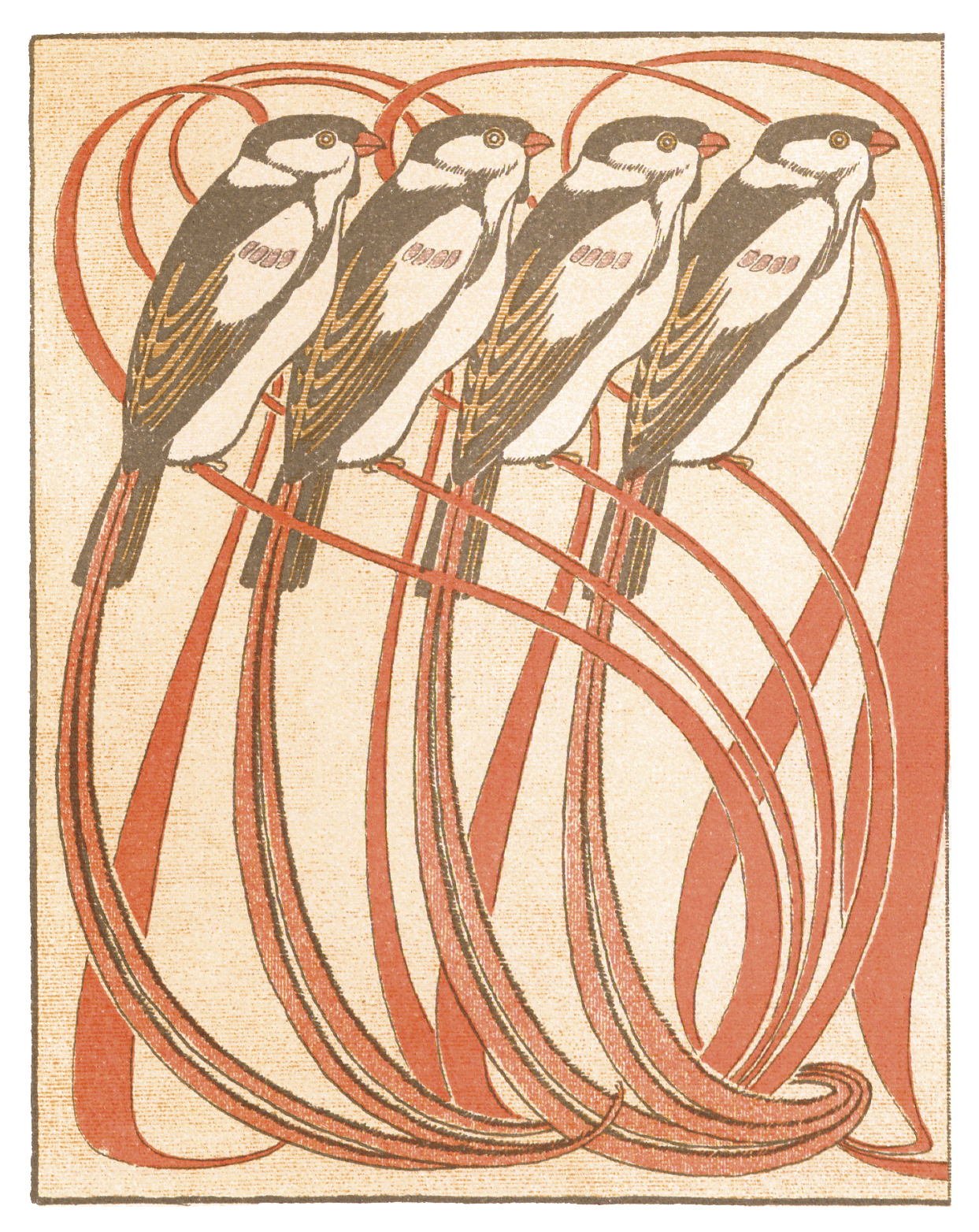
It is always interesting to see how certain historical art movements come back into fashion decades or even centuries after they have reached their zenith. Take for example the style of Art Nouveau, meaning “new art”. This was the name given to an artistic movement in european art in the late nineteenth century. Much of its inspiration came from natural formations and asian art and design. Some of the most popular artists from this era include Toulouse-Lautrec, Aubrey Beardsley, and Alphonse Mucha. Recently, many of the stylistic trends originally set forth by these masters have been resurfacing in many of the current art movements. “Art Nouveau” has found a new home within the pop-surrealist community, particularly among the ladies. Some of these artists include Audrey Kawasaki, Stella Im Hultberg, and Sylvia Ji.

Continue reading

15 Websites and Magazines for Artists

As an artist it is important for you to keep informed about what the market is up to and where you fit in. Develop a strategy that will allow you to keep abreast of current trends and events. Subscribe to magazines that appeal to you. Subscribe to online newsletters that let you know what is happening in your area. Get yourself on as many social networking sites as you can. Here is a partial list of sites and magazines to get you started:

Continue reading

Market and network like the pros

If you are serious about being an artist and marketing your artwork, you want to be taken seriously by curators, collectors, and other artists. It is vitally important that you pay attention to what other artists, collectors, and curators are up to. Artists learn by looking; it is simply indispensable in the profession. However, you would be surprised just how many artists there are out there who skip the necessary steps to get their feet through the right doors.

Continue reading

Why Should Artists Blog?

by Nancy Haberman

It seems these days everywhere you look, people are talking about using the internet to earn money. Regardless of whether you’re an entrepreneur running an online store or an artist displaying your work online, your goal should be to drive qualified traffic to your website. A qualified visitor is someone who is genuinely interested in the products or services being promoted, and who is ready to take a specific action (called a conversion), such as making a purchase, filling out and sending in an online form, or calling to schedule an appointment.

Anyone can publish a website, but unless you have a plan of action and know what you want your site to achieve, it will be next to impossible to determine if you are successful. Don’t make the mistake of thinking that once a website is posted, your job is done. That’s like opening a store and forgetting to advertise that you are open. Once a website is online, your marketing has just begun.

Continue reading

15 ways to sell your artwork

There is nothing better as an artist than to see someone display your work and to know that they love and appreciate it. Whether art is a hobby or you earn a living with it, there are always opportunities to sell your art. If you are struggling with how to go about it, the ideas below can be combined to create your own strategy for marketing your work.

Artist Cards, Editions and Originals (ACEO) – use as business cards to promote your work. Your original art on the front, your contact & product information on the back.

• Bookmarks – again, use as a business card with your art on one side and your information on the other.  Bookmark tassel and sleeve sets can get you started.

• Promotional pieces – T-Shirts, coasters, mugs, etc. – Check out Cafe Press.  Wear your art – “mobile marketing” – then hand out an ACEO or bookmark when someone is interested in your art.

• Mail your art
– Use postcards of your art to advertise your work, sell sets of postcards or give as gifts
– Envelope art – advertise as you send out your mail

• Sell prints. These days it is easy. Fine art printing companies are widely available on the Internet and elsewhere. Many of them do digital capture as well as the printing itself.

• Develop a blog or your own online gallery. At a minimum, get a simple web page where people can view your work and contact you – people expect this.  Get a free hosted blog at WordPress.com. If you decide you want your own website, check out free web hosting here, then get free blogging software for your website at WordPress.org.

• Sell on eBAY or ETSY – great places to sell your specialty greeting cards or even original art. List your work on eBay to appeal to consumers who don’t have the time or inclination to pay gallery prices. Set a reserve price that assures you’ll get a decent return on your time.

• Art shows – This can be a great way to get your work seen in the local market. Galleries often host these shows, so they do all the advertising. See our recent blog article for information on shows and how to prepare for them. To find shows in your area you can go to festivalnet.com, or Google “craft show index”.

• Set up a booth at your local farmers market, flea market or swap meet to sell your work. This can be fairly inexpensive.

• Ask to have your art displayed at local libraries, restaurants, Barnes & Noble in the café area, etc.

• Sell through an online artist cooperative.

• Network – join museum or artists’ groups and local business community groups.

• Enter competitions.

• Display or sell your work at church & temple bazaars and holiday boutiques, convention centers and community centers.

• Approach companies that will sell your product. Just because you are an individual, don’t assume that companies won’t want your product. Check out Lady Bones.

How do I measure my artwork for matting?

By David Heyman

A mat makes any image look more professional. Even without a frame, simply matting your photographs or artwork will do wonders for the presentation, and sales potential, of the work.

Although mats come in many standard sizes, if you are working with custom size images, or anything that is done on a paper that is a creative size, your mat will need to be custom cut. Oak Creek Printworks offers custom cut mats, at a cost relative to a standard size mat, with no extra charges.

How to give the correct measurements for a custom mat is one thing that many artists find confusing. Since custom cut mats are cut to order, it is important to have your borders and window measurements accurate. While you can always call David, our custom picture framer, at (805) 390-4955, with any questions on sizing of borders and windows, the following is a guide that will give you reliable results:

  • Measure the outside edges of your image. Do not assume your image is a certain size. You may have ordered an 8″ x 10″ photograph, but the image actually measures 7-7/8″ x 9-7/8″. If you are matting artwork on paper with an uneven edge, such as a deckle edge, measure the narrowest part of the horizontal and vertical sides, as shown in this photo.

* Add photo of deckle edge watercolor paper, showing w/ ruler how to measure*

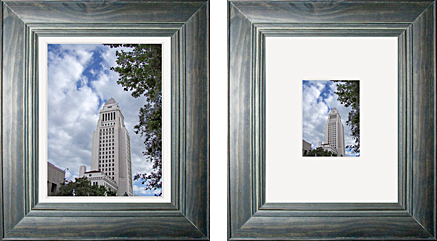
  • Decide if you want even borders for your mat, or a weighted edge. Some people feel that having the bottom border of the mat slightly wider makes the image seem more centered when viewed from a distance. This is called an “optically centered” window.

CenOPCenMats2

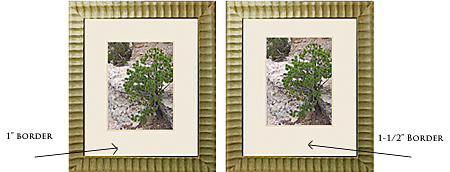
  • How wide do you want your mat? A narrow mat allows the image to stand out more and can fit a tight frame. A wide border gives the work dramatic presence and can transform a small image into a large piece. Whichever you decide is up to you, it is just a matter of personal taste. Here are examples of both styles:

NarrowWideMats

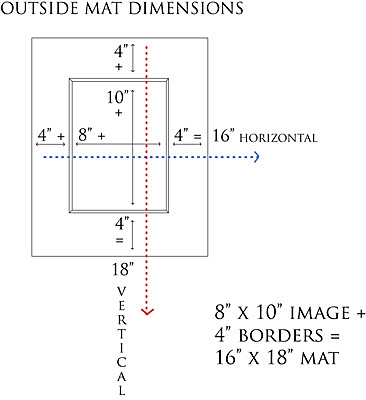
  • When you have this information, perform these two simple calculations, and you are ready to go: To get the outside dimension of the mat, add the horizontal dimension, the width of the mat and the width of the mat again. For example, if your image is 8″ x 10″, and you want a 4″ wide border, add 8 + 4 + 4 = 16″. Do the same with your vertical dimension, in this example – 10″ + 4 + 4 = 18″. So your outer mat dimension is 16″ x 18″.

OuterMat

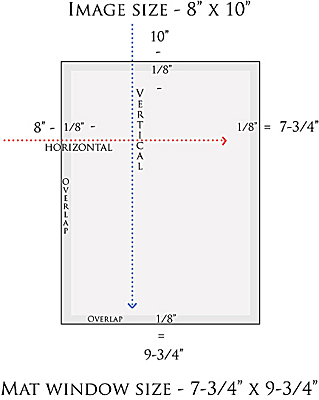
  • The second calculation is your window size. That is simply your image size, minus a slight amount for overlap. Since the window will cover the edges of the image, it needs to be slightly smaller than the artwork. We recommend a 1/4″ overlap, which will allow enough room for overlap and attachment to the back of the mat. In our example, with an 8″ x 10″ image, your window size would then be 7-3/4″ x 9-3/4″.

Print

With practice, this process becomes second nature, and can be quickly transformed into a host of eye-catching sizes for all of your pieces. Taking a little time to measure your own custom mats can save you much time when preparing your shows and matted prints. Which will then give you more time to do what you do best – creating!

Artist Trading Cards

Artist Trading Cards
Art Card Editions (ACEO)

Give an Art Card, Edition or Original, as a Stocking Stuffer
By Trevor Mauk

Countless artists today are trying to find new ways to have others experience their art. Many of them have turned to the Internet, and have had great success.  But a new, easy way to have your art in the hands of others is becoming more and more popular. Artist Trading cards, or ATCs, are opening a new world of artistic experience to both experienced and amateur artists across the world.

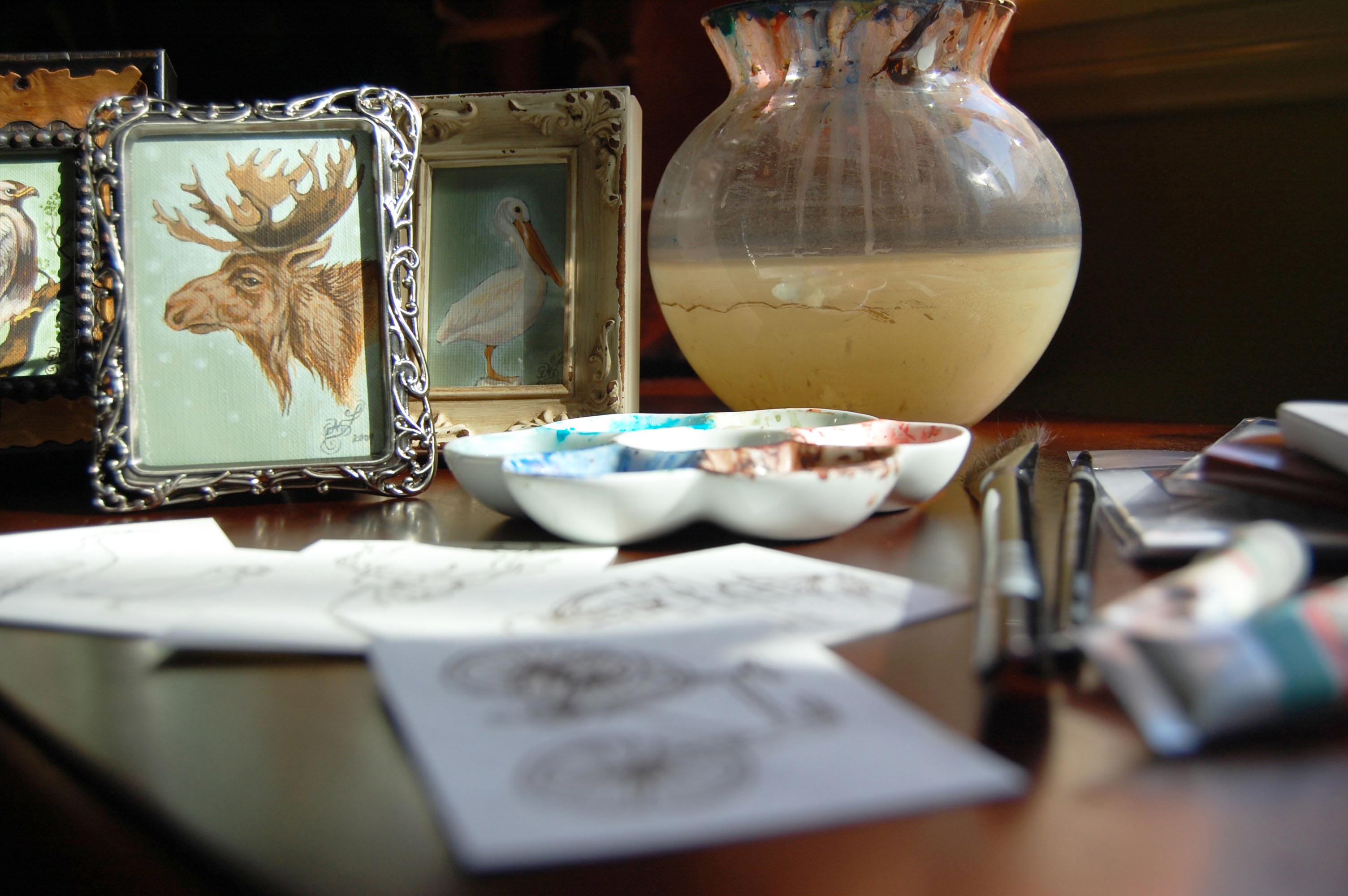
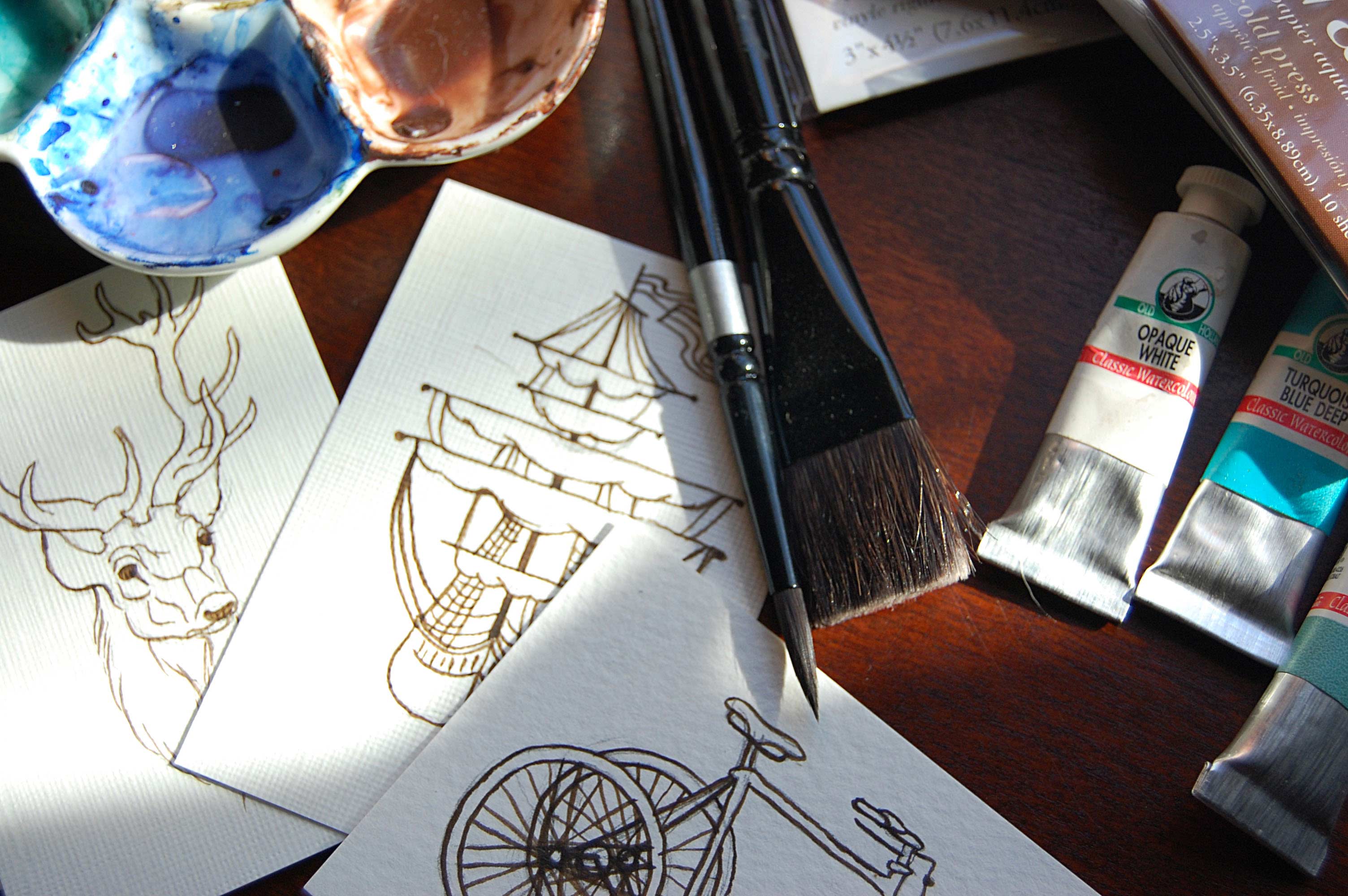
ATC-studio watercolor-setup

Artist trading cards were created in 1997 in Switzerland by Michael Leavitt, who was inspired by the idea of baseball trading cards. They are approximately 2.5 by 3.5 inch cards with an original piece of art that is created directly on the front, and with information about the artist who created it on the back. The individual cards are typically originals or part of an edition. The medium that the art is created on is limitless. Drawing, painting, photography, and three-dimensional objects can also be used on the cards. The only limitations for creating an ATC is that the card must be 2.5″ by 3.5″, and flat enough to be put into an envelope. Past these rules, the potential is endless, opening a wide range of possibilities for artists creating them. The small size has also pushed artists to create something very different than anything they have made before on their typically large canvasses.

Artist trading cards were not created with the intention of making money, but rather purely to experience art from others and to be able to share your own art as well. Therefore, they were intended to be traded and not sold. There are websites dedicated to arranging ATC trades, such as www.atcsforall.com, to make it very easy to start trading and to become part of the ATC community. The idea of physically trading these original pieces of art either through person or the mail has made this experience so much more genuine than experiencing art on the Internet. Having an original piece of art at your fingertips is oftentimes much better than viewing it on your computer screen.

Many artists who create ATCs also create their own envelopes that compliment their piece. It is also a good idea to put them in clear plastic pockets for storage and shipping to keep them protected. There are also specially sized boxes made for storing ATCs safely. A photo-album is a good way to keep ATCs protected and to look at them easily too. Some artists have been very creative with how they show and store their cards, whether it be sewing a plastic window on their handbag to display them, or framing them to show in their home.

In a world where so many artists are trying to find a way to have their art viewed by others, artist trading cards have opened up a new way to share original pieces in an easy, genuine way. With the artist trading card community growing, it is sure to open up a new artistic experience for artists of all types across the world.

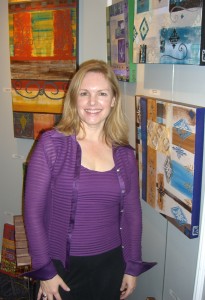
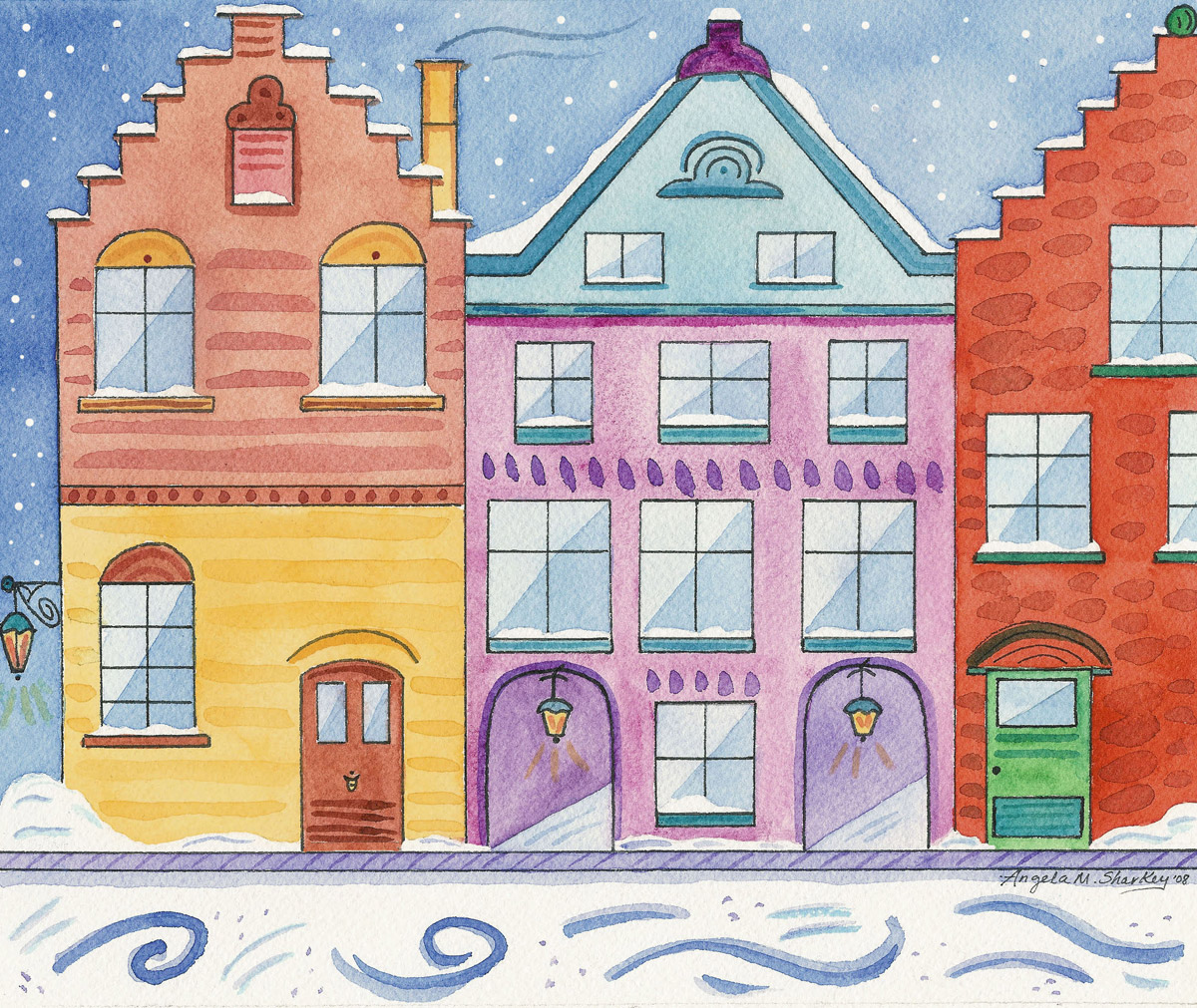
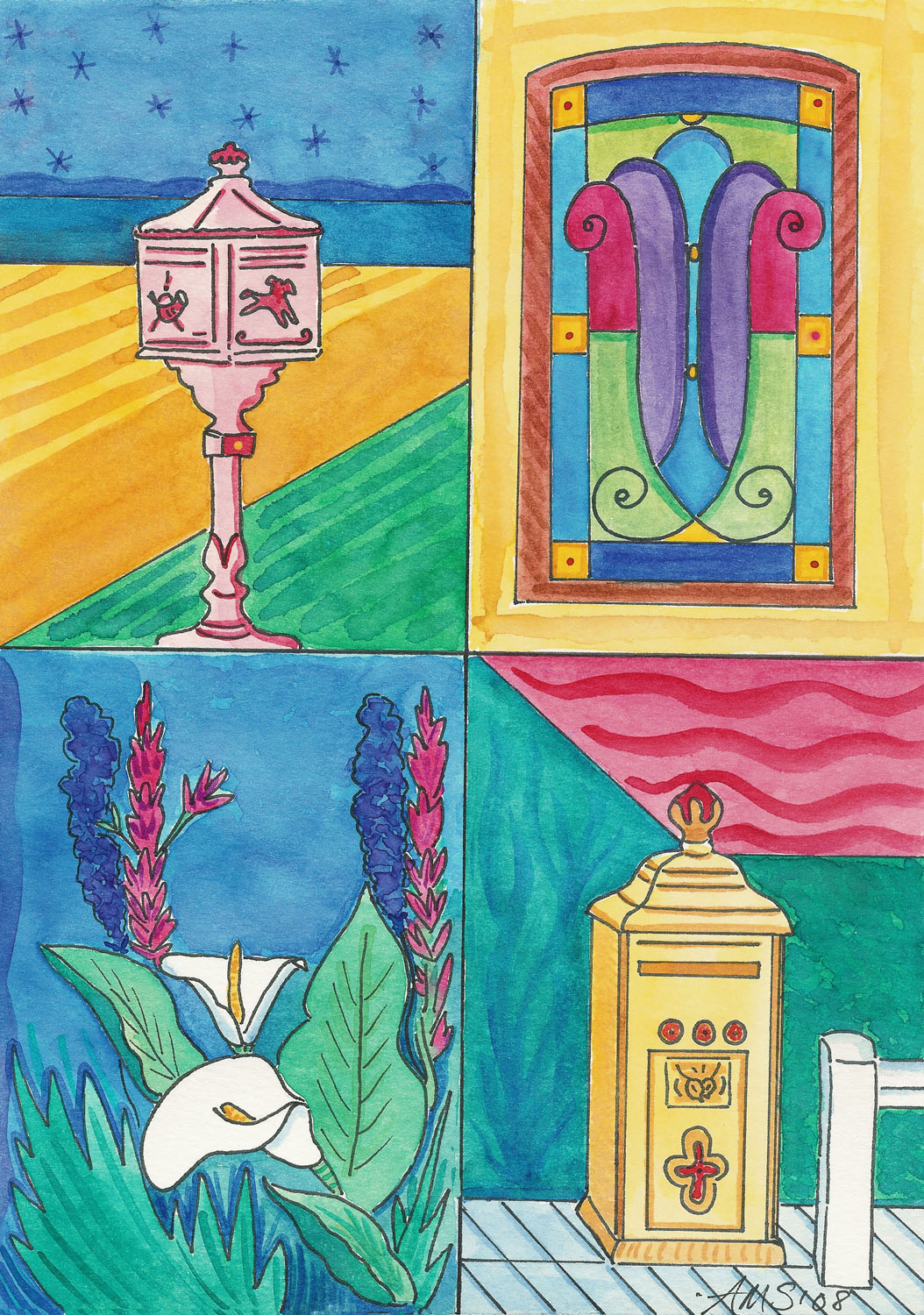
Angela M. Sharkey, Winter 2009/2010 Featured Artist

angela_sharkeywww.angelasharkey.com

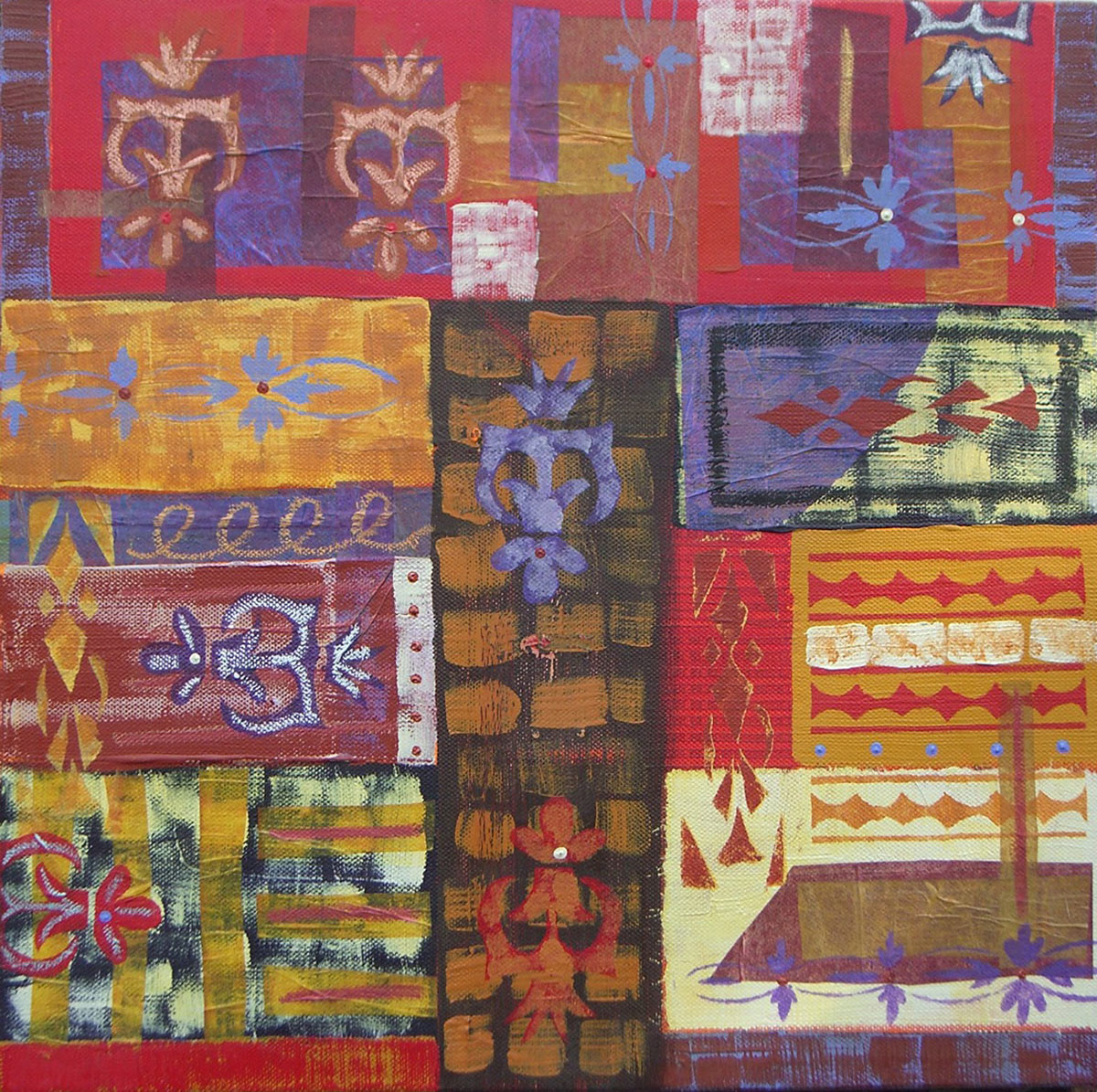
Angela Sharkey’s eclectic style of art is constantly evolving as she brings her visions to life with an emphasis on color, design and texture.  Having a background in graphic design, she is always aware of balancing shape, color, and line in her artwork.  Working in a variety of mediums, she uses layers of various textures in her paintings along with her hand-designed stencils and her own richly colored papers. She invites the viewer to explore the rich and varied landscapes she creates, telling a story through her work.  Architectural elements, iron works, patterns and ornamentation are throughout her work as she freely manipulates and applies these designs, letting them influence her art.  Angela’s marriage of color and pattern weave a tapestry on the canvas as her visions take shape.  Frequently moving around the world, Angela is continually inspired by her new surroundings and how they affect her perspective on life; Angela imbues this reflection in her work.

In her own words

My love for art and expressing myself artistically is an integral part of who I am and I have been creating art for over 20 years.  My art career started as a graphic designer after I studied at the Milwaukee Institute of Art and Design and has evolved into painting.  My current répertoire consists of acrylic, mixed-media, watercolor, and pastel on a variety of surfaces. Deep edge canvases are my choice for painting; I love the fact that when I’m done I can paint the sides and have a painting ready to hang without framing.  Sketching my ideas, creating my own stencils, and hand coloring papers are all part of the process for me when I start a painting. The meditative act of stencil making and hand painting papers as well as sketching some ideas gives me a perspective and direction as to where my painting might go.

bijouxMixed-media painting has allowed me to tap into my creative well unlike other forms of painting. I am always working towards a tactile and intricate appearance, so I use glazes, heavy body acrylics, and various gel mediums.  I like to use common objects such as a wine cork, plastic wrap, or a brayer  and experiment with bringing texture or even design into my paintings.  Building up a painting with many layers and then scraping or scrubbing away until I get the desired effect or look I want has been very fulfilling.  Inspiration comes from my daily life; whether it is beautiful architecture and all its elements, gorgeous colored flowers I see on a walk or historical design and pattern books–I absorb it all.  As much as I prepare for my paintings, I am still led by my emotions when I paint and I always succumb to my inner feelings.  I have also turned my art into my own greeting card line that I sell locally to friends and through the U.S. Embassy in Belgium where I am currently living.  My greeting cards are a reflection of my love for color and are illustrative and whimsical in nature.  Pushing my boundaries and experimenting as an artist, I really enjoy melding paint and graphic design together, which always leaves me wondering what I can create next.  I take an idea and let it evolve trusting the creative process and my intuition while being open to the unpredictable.  I have participated in group shows and art fairs in Belgium and my artwork is displayed in the United States and Europe.
Snowy-streetWeb waiting-for-mailWEB

THE ETIQUETTE OF LETTER WRITING

by Georgia Lange

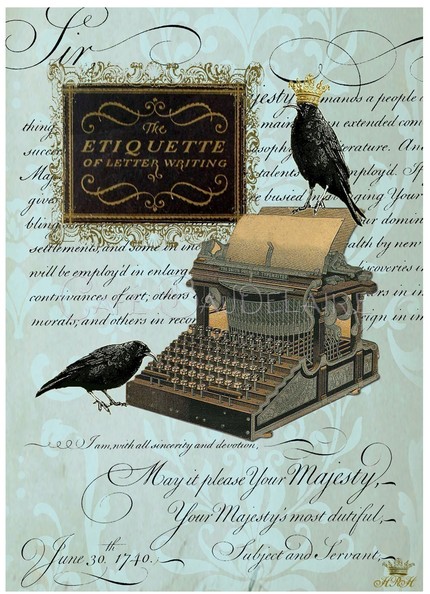
etiquette of letter writing

Original artwork and design by Wendy Patterson of Cafe Baudelaire

etiquette |etikit; -ket| – noun
the customary code of polite behavior in society or among members of a particular profession or group


Several months ago, I was listening to NPR and tuned into a discussion about handwriting. It was under debate whether handwriting is a dying practice in the digital age of communication. People rarely write hand-written letters anymore; the vast majority simply send an email or a digital greeting card. As I listened to the discussion, my inner fine artist started to cringe; I remember hearing similar discussions at the School of the Art Institute of Chicago (SAIC) over the future of painting, museums, hand-drawn animation and so forth. Traditions live on because we as a society choose to honor them by continuing their practice. There is something special about the tradition of creating things with our hands, and it is important not to lose the little things (such as handwriting or hand-written letters) just because modern technology makes it so much easier for us. Whatever your craft, your hands are as unique as your fingerprints. What you create using them is just as unique as you are, and just as precious.

Sending a hand-written letter has a much more personal and classy touch than an email. There are many ways to turn your hand-written letters into something extra special. Try writing with a quill pen or sealing your letters with a wax seal. This adds an artistic element to your letters giving them a more vintage and romantic quality. Check out nostalgicimpressions.com for an excellent selection of sealing wax, seals, and quilled pens. If this kind of etiquette appeals to you, than you are truly an artist at heart. Creating your own greeting cards with your art on them is the best way to turn your letters into gifts.

Giving someone a piece of your artwork, be it a print or an original, is a truly special kind of gift because it comes directly from you, and it makes the recipient feel just that much more special. The same principle also applies to greeting and gift cards. Maybe there are people in your life that you feel you do not have a close enough relationship with to warrant giving them a gift, but you still feel the need to let them know you are thinking of them. You may also have friends who are spread out across the country to whom you cannot afford to ship presents, but you still want to wish them a happy holiday season. Sending a greeting card with your original artwork printed on it is similar to sending a fine art print on a smaller scale. If you have your greeting cards printed in a 4 x 6 or 5 x 7 inch size, the recipients can easily place it in a frame turning a simple card into a work of art that can hang on their walls. It is also cost effective and allows you as an artist to market your work and your talent. Save that box of holiday greeting cards that you bought on post-holiday sale at Barnes and Noble or Borders last year and make your greeting cards more intimate and personal with a touch of the artistic and a touch of you.